Our Products
WASTE WATER EVAPORATOR
Evaporators operate on the principle of heat transfer and phase change, converting a liquid into a vapor by applying heat and then separating the vapor from the remaining liquid. This process is used to concentrate on solutions or separate volatile components from non-volatile substances
Evaporators effectively reduce the volume of wastewater by removing excess water. This process helps manage waste more efficiently and recover valuable resources from wastewater streams.
Types of Evaporators
Falling Film Evaporators
Falling film evaporators create a thin film of liquid that flows downward along the inner walls of vertical tubes or plates. The liquid is heated as it descends, causing rapid evaporation with minimal residence time.
This design is ideal for heat-sensitive, non-crystallizing solutions and is widely used in food, dairy, pharmaceutical, and chemical processing due to its gentle handling and high energy efficiency.
Thin Film Evaporators
Thin film evaporators use a rotating mechanism to spread liquid into an extremely thin, continuously renewed film over a heated surface. This allows for very short residence times and high heat transfer rates, making them suitable for viscous, heat-sensitive, or fouling materials.
They are commonly used in the pharmaceutical, fine chemical, and food industries for concentrating challenging products.
Wiped Film Evaporators
Wiped film evaporators are a specialized form of thin film evaporator where rotating wiper blades continuously renew the liquid film on the heated surface. This design maximizes turbulence, prevents buildup, and is highly effective for processing high-viscosity, heat-sensitive, or fouling-prone fluids.
They are used for difficult distillation and concentration tasks in chemical and pharmaceutical manufacturing.
Forced Circulation Evaporators
Forced circulation evaporators employ pumps to circulate liquid at high velocity through heat exchangers, preventing localized boiling and fouling. This design is effective for concentrating viscous, scaling, or crystallizing solutions and is suitable for applications where the product might otherwise deposit on heating surfaces.
They are used in wastewater treatment, chemical, and food industries.
Agitated Thin Film Evaporators
Agitated thin film evaporators combine thin film technology with mechanical agitation, using rotor blades to actively spread and renew the liquid film. This ensures high heat transfer and minimal fouling, making them ideal for high-viscosity, heat-sensitive, or challenging fluids.
They are used in industries such as chemicals, food, and environmental processing.
Multi-Effect Evaporators
Multi-effect evaporators (MEE) consist of multiple evaporator units arranged in series, where vapor from one stage is used to heat the next. This cascading use of energy significantly improves efficiency and reduces steam consumption.
MEEs are ideal for large-scale operations with high throughput requirements, such as desalination, wastewater treatment, and food processing.
Mechanical Vapor Recompression MVR Evaporators
MVR evaporators use a mechanical compressor to compress and recycle vapor produced during evaporation, using it as the primary heat source for further evaporation. This dramatically increases energy efficiency and reduces operating costs.
MVR systems are suitable for large scale industrial and municipal wastewater treatment, as well as applications requiring high water recovery and low energy use.
Heat Pump Evaporators
Heat pump evaporators use a heat pump to transfer heat from the environment to the liquid, vaporizing it efficiently.
They are more energy-efficient than direct heating methods and are suitable for applications where low-temperature operation or reduced greenhouse gas emissions are important.
Plate Evaporators
Plate evaporators use a series of plates to create thin films of liquid for efficient heat transfer and evaporation.
They are compact and often used in food and beverage processing, especially for products like milk, juice, and syrups.
Rising Film Evaporators
Rising film evaporators operate similarly to falling film designs, but the liquid rises through heated tubes, forming a film as it vaporizes.
They are suitable for low-viscosity liquids and are used in food, chemical, and pharmaceutical industries
ZEPOWAL Treatment Process for Evaporators
This treatment process is used to remove pure water from the waste water leaving behind impurities and sludge. Evaporation is accelerated by solar thermal energy in a solar thermal cell, where a certain quantity of waste water is stored. Air gets humidified and leaves at higher humidity levels > 90%. This process substantially reduces the carbon footprint, has zero consumables, has a compact design, and is easily adaptable to input wastewater quality.
Additional Notes:
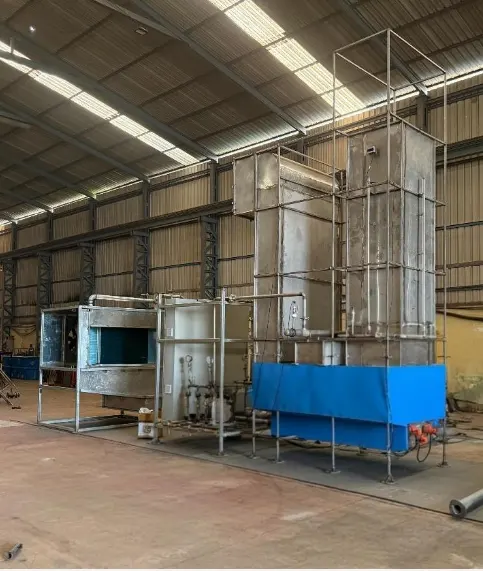
Amongst these Forced Circulation and Multi-Effect evaporators are generally used for waste-water treatment. This helps industries to attain the ZLD (ZERO LIQUID DISCHARGE), made compulsory by the State Pollution Control Board/Central Pollution Control Board.
We offer Waste water evaporators to achieve this milestone by range of evaporators. Evaporators are available with design, user-friendly operation for continuous reduction in water portion of water-based wastes. It not only eliminates the waste water but drastically reduces the amount of waste that needs to be transported.
Evaporators are available in the capacity from 20 L/Hr. to 3000 L/Hr. The mode of source heating can be varied in Electrical, Steam, Diesel, LPG/PNG. The evaporator’s net volume can be 400 Liters To 8100 Liters per day depending on selection of multi models.
Condensate recovery, if desired, done using surface condensation, can be achieved from 10% – 50% depending on the type of inlet water. This condensate will be suitable for feed water of boiler and may reduce boiler fuel needs by 20% approx